About Us
The State Police Headquarters, which was earlier located in the Civil Secretariat, Chandigarh
has now been shifted to its own building in Sector 6, Panchkula. The Central Police Office
(C.P.O), Criminal Investigation Department Offices are located in this building, alongwith
the State Police Control Centre.
The Criminal Investigation Department is as old as the organized Police Department,
because collection of intelligence is a very vital instrument for maintenance of law and order.
The State Criminal Investigation Department is based at the State Capital.
Presently following officers are posted in CID:
| S. No. |
Designation |
Name (Shri/Smt.) |
| 1. |
ADGP/CID |
Saurabh Singh, IPS |
| 2. |
IG/Security |
Pankaj Nain, IPS |
| 3. |
IG/CID |
Naazneen Bhasin, IPS |
The CID Training School and Commando Training Centre both are located in Panchkula.
Anti-Terrorism Squad (ATS), Haryana
The Anti-Terrorism Squad (ATS), Haryana has been constituted as a specialised agency under the
Crime Investigation Department (CID), Haryana, to strengthen the State's capability to prevent,
detect, disrupt, investigate and effectively respond to terrorism and related threats.
The Government of Haryana, vide Notification No. 90-2026/Ext. dated 10 June 2026,
has established two dedicated ATS Police Stations at Panchkula and Gurugram,
covering the entire State.
Constitution & Composition
ATS Haryana is headed by the Inspector General of Police, ATS, reporting to DGP Haryana
through ADGP/CID, and comprises:
- IGP, ATS
- SP, ATS Headquarters
- SP, ATS Panchkula
- SP, ATS Gurugram
- DSPs, Inspectors and other investigation/intelligence personnel
- Specialised technical, cyber, forensic and operational teams
- Special Force Commandos
- Special Operations Groups (SOGs)
Mandate
The core mandate of ATS Haryana is:
- To collect, develop, analyse and act upon intelligence relating to terrorism, terrorist organisations, modules, operatives, facilitators and emerging threats.
- To prevent and disrupt terrorist activities, networks and their support ecosystem, including over-ground workers, logistical networks, safe houses and other facilitators.
- To act as the first responder to terrorist incidents and undertake specialised counter-terrorism operations for containment, intervention and neutralisation of terrorist threats.
- To conduct professional, scientific and evidence-based investigation of terrorism and terror-related offences, including conspiracy, recruitment, harbouring, facilitation and other connected activities.
- To identify and disrupt terror-financing and illicit financial networks, including hawala channels, circulation of counterfeit currency, proceeds of terrorism and other financial channels used to fund, facilitate or sustain terrorist activities.
- To act against narco-terrorism and investigate and disrupt the nexus between narcotics trafficking and terrorist or extremist organisations.
- To identify and disrupt illegal arms, ammunition and explosives supply networks having linkage with terrorist or extremist activities.
- To prevent and counter radicalisation, propaganda and recruitment, including online recruitment of cadres and misuse of cyberspace and social-media platforms for terrorist purposes.
- To develop intelligence and take coordinated action against the wider terrorist ecosystem, including financing, communication, logistics, weapons supply, recruitment and technological support.
- To undertake preventive and de-radicalisation measures against extremist mobilisation and recruitment, particularly among vulnerable individuals and groups.
- To coordinate and share intelligence in real time with Central and State agencies, including IB/MAC, NIA and other security and law-enforcement agencies, for effective prevention, investigation and response.
- To maintain specialised operational readiness for responding to high-risk terrorist situations and assist other agencies whenever required.
- To undertake such other intelligence, investigative, preventive and operational measures as may be necessary to detect, prevent, disrupt and neutralise terrorism and activities having a nexus with national security.
ATS Police Stations with Jurisdiction
| S. No. |
ATS Police Station |
Districts Covered |
| 1. |
ATS Police Station, Panchkula |
Panchkula, Ambala, Kurukshetra, Yamunanagar, Karnal, Panipat, Kaithal, Hisar, Hansi,
Fatehabad, Jind, Sirsa, Rohtak, Bhiwani and Charkhi Dadri. |
| 2. |
ATS Police Station, Gurugram |
Sonipat, Jhajjar, Gurugram, Faridabad, Palwal, Nuh, Rewari and Mahendragarh. |
Officers Posted in ATS
| S. No. |
Designation |
Officer |
| 1. |
IG/ATS |
Smt. Nazneen Bhasin, IPS |
| 2. |
SP/ATS HQ |
Smt. Upasana, IPS |
| 3. |
SP/ATS |
Sh. Varun Singla, IPS |
ATS Haryana is committed to strengthening the State's counter-terrorism architecture through
intelligence-led prevention, specialised operations, professional investigation,
technology-enabled capabilities and effective inter-agency coordination.
The State Crime Branch was established in 2006. This Unit is based at Moginand, Panchkula.
The following officers are posted in State Crime Branch:
| S. No. |
Designation |
Name (Shri/Smt.) |
| 1. |
IGP/Crime |
Rakesh Kumar Arya, IPS |
| 2. |
DIG/Crime |
Virender Vij, IPS |
The Haryana Armed Police Comprises of Six battalions, three of which are based at Madhuban near Karnal.
Two battalions are based at Ambala and Hisar & one battalion (Durga Shakti 1st Bn.) is based at Sunaria, Rohtak.
On creation of Haryana State, on 01.11.1966, six battalions of Punjab Police were transferred to this state.
These included four Government of India Reserve Battalions which were later merged in Border Security Force/Central
Reserve Police Force etc. Subsequently, only two battalions were left and they were stationed at Ambala City and
Nilokheri on temporary basis. 1st Bn. is still continuing at Ambala City. The Hqrs of HAP was shifted to Madhuban in the year 1968.
Keeping in view the needs of law and order in the state, 3rd. Bn. HAP was raised in the year 1969 with its headquarters at Hisar.
Thereafter, the 4th Bn, HAP was raised on 14.09.1973 as a technical battalion to maintain essential services like electric supply
and road transport during any employee strike. But due to the policy of transfer of HAP personnel to District Police adopted
from 1979 onwards, this battalion is now like any other battalion. The state Police Bands are part of the HAP under the 2nd Bn.
HAP, Madhuban. The Mounted Armed Police which has 90 mounts is a part of 4th Bn. HAP, Madhuban. The Haryana Armed Police has
excelled in the field of sports and games especially in Wrestling, Volley Ball, Kabaddi and Football.
1. Haryana Police Public School
An English medium school namely Haryana Police Public School has been started in the Madhuban Complex to impart quality education
to the wards of police personnel. The school is managed by governing body consisting of senior officers posted at Madhuban.
There are about 900 students in the school. This is purely a private school. At present, the Haryana police public school is known
by DAV, Police Public School and working under the Director, Haryana Police Academy, Madhuban.
2. Hospital
A hospital with 16 beds is functioning on Police Complex, Madhuban. It has pathological laboratory and x-ray facilities.
A dental unit is also available in this hospital. At present, two medical officers one is from HAP and other is from HPA
are present and one dental surgeon from HAP is also posted in this hospital. Besides this hospitals for 1st Bn., HAP,
Ambala City and 3rd Bn., Hisar are also functioning at Ambala & Hisar separately.
3. Mounted Armed Police
On bifurcation of Punjab state on 01.11.1966, 96 horses were allotted to Haryana Police. Now this HAP unit is functioning
under the supervision of Commandant 4th BN, HAP Madhuban. At present, there are 43 horses. The Mounted Armed Police is
distributed among 06 police out posts in various districts for patrolling sensitive areas among the border of UP, Punjab,
Rajasthan. Our MAP has so far 113 Gold Medals, 98 Silver Medals and 90 Bronze medals in the International/National Equestrian Meet.
The Telecommunication wing is the Communication and Technical wing of the Police Department.
The Police Telecommunication Wing is presently headed by Shri. Vikas Arora, IPS, ADGP.
This wing came into existence on the bifurcation of Punjab State on 1.11.1966 and was known as Wireless wing.
At that time, there were 13 HF stations functioning in Seven Districts of the State.
The Headquarter of the Wireless wing was established in a rented building in Kothi No. 32 Sector 2-A, Chandigarh.
The Sanctioned manpower to run the functioning of this wing was meager i.e. Inspector/2, Sub-Inspectors/20,
Assistant Sub-Inspectors/85, Head Constables/5, Constables/21.
With the passage of time the Number of Police Districts in the State have risen to 24.
Now in each District Control room there are 7 communication channels functioning to convey information
relating to the crime, law & order etc., with a total Numbers of 3365 Wireless stations
(i.e. Static, mobiles and Walkie talkie).
At present the Sanctioned strength of the Telecommunication wing is IGP/1, SP/1, DSPs/10, Insprs./42,
SIs/121, ASIs/274, HCs/558, Consts/902. At present the Headquarter of the Telecommunication Wing is
functioning at SERC, Dial 112 Building, Sector 3, Panchkula. The State Level Police Telecommunication
Training Centre alongwith workshop are located at Moginand, Panchkula.
The Railway Police headquarters is located at Ambala Cantt. It has 3 sub divisions
located at Ambala, Faridabad & Hisar. There are 16 Railway Police Stations and
24 Police Posts in the State.
The G.R.P has a strength of SP/1, Dy. SP/3, Inspector/20, SI/47, ASI/133,
HC/198 and Const./1060. As many as 693 trains pass through Haryana every day and
Government Railway Police is engaging in providing safety and security to the
traveling public.
Presently Railway Police is headed by
B. Sateesh Balan, IPS, IGP/Railways & Commando, Haryana, Panchkula.
Most of the area of GRP/Haryana falls under the Northern Railway. Four Govt. Railway Police Stations
Kalka, Chandigarh, Ambala Cantt & Jagadhari fall under the jurisdiction of Divisional Railway Manager
Ambala Cantt, Nine Govt. Railway Police Stations Kurukshetra, Karnal, Panipat, Sonipat, Faridabad,
Bahadurgarh, Rohtak, Jind & Gurugram fall under the jurisdiction of Divisional Railway Manager New Delhi
but 34 K.M. Area falls under the jurisdiction of Divisional Railway Manager Agra, One Govt. Railway Police
Station Rewari falls under the jurisdiction of Divisional Railway Manager Jaipur, Two Govt. Railway Police
Stations Hisar & Sirsa fall under the jurisdiction of Divisional Railway Manager Bikaner.
Delhi-Ambala, Delhi-Hodal, (Upto Jhansi-Agra) and Delhi-Rewari sections are very important from the
Railways point of view of movement of goods and passengers. These sections have Superfast, prestigious
and long distance trains, whose security is the responsibility of Haryana Government Railway Police.
There are 03 sniffer dogs also deployed into service at the platforms of important Railway stations
and on important trains.
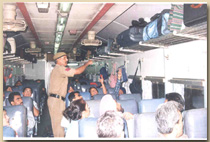
Haryana Police Academy, Madhuban was established in the year 1975 to impart training to newly recruited
Police Personnel in the State of Haryana. The campus of Academy spreads over 695 Acres on the sides of
NH-44, at Madhuban in district Karnal, Haryana. This Police Academy has trained 3,10,243 Nos. of trainees
from its establishment till 31st January, 2025 including trainees from other States like Nagaland, Manipur,
Himachal Pradesh, Jammu & Kashmir, Bihar, Andaman & Nicobar and CPOs like CISF and CBI, etc. The officers
belonging to the Haryana Judicial Services, Haryana Civil Services (Executive Branch), Prosecution, Haryana
Prison Department, Indian Revenue Services (Custom & Excise), Customs & Indirect taxes Department and
Home Guards are also imparted training here.
Under the aegis of BPR&D with the collaboration of U.S. Embassy, the Academy got privilege to organize
National Level Anti-Terrorist Activities (ATA-8211) Investigative Information Management Course for Senior
Police Officers of our country. With the collaboration of Ministry of Home Affairs and BPR&D and US Embassy,
Haryana Police Academy also got privilege to organize ATA 9678 Interdicting Terrorist Activities Course for
Senior Officers of NIA, ITBP, NSG, CRPF, SPG, BPR&D, NPA & BSF.
In view of the complexity of crimes alongwith increasing cyber crimes training programmes are regularly updated
and specially designed to enhance the investigation skills of our IOs. Special arrangements have been made to
impart training to the trainees in relevant subjects like Human Rights, Traffic Management, Crowd Control,
Multi-Media, Stress Management, Soft Skill, Cyber Crime, CCTNS, Community Policing and Police-Public Relations.
All essential facilities of excellent standards i.e. Air Conditioned Auditorium with sitting Capacity of 500
trainees, Conference Hall having seats capacity of 50 of Officers, Library, Gym, Museum, Auditorium, Language
Lab, Conference Halls, Computer Lab, Multi-Media Cell, Sand Model Room, Cyber Lab and Investigation Lab, Hockey
Ground, are being used for imparting training in this Academy. This academy is also having infrastructure for
various sports like indoor Badminton Court, Hockey Ground and Football Ground, Olympic Size 400 meter Synthetic
Track. A State of art Police Museum has been built to preserve heritage of Haryana Police for the trainees,
staff and people. Indoor Firing Range of distance 50 meters with two Bays and firing simulator are also
available in this academy.
Forensic Science Laboratory
Established at Rohtak in the year 1973 and later shifted to Madhuban (Karnal) in 1976.
Main FSL is functional at Karnal & 4 RFSLs are functional in Gurugram, Rohtak, Hisar & Panchkula.
At present it comprises of 1 Main FSL, 4 RFSLs & 23 sanctioned MFSUs.
A dedicated Cow/Animal meat testing laboratory is also being established at RFSL Gurugram.
Brief Note on Functioning of Various Divisions/Sections in FSL and RFSLs
1. Biology
This division focuses on the examination and analysis of biological samples, such as blood, semen, saliva, hair, tissues, vomit, diatoms etc. in diverse type of cases. Further, FSL Haryana has a dedicated Diatomology unit for examination of cases pertaining to drowning.
2. Serology
The Serology division identifies and analyses body fluids such as blood for detection of species origin and blood group matching which support investigations into sexual assault, murder or other violent crimes.
3. DNA
This division specializes in extracting, analyzing, and matching DNA from biological samples, playing a crucial role in identifying individuals or linking suspects to crime scenes through genetic evidence.
4. Ballistics
The Ballistics division investigates firearms, ammunition, and related evidence to determine the type of weapon used in crimes, ballistics patterns, and the potential connection between fired bullets and firearms.
5. Chemistry
This division analyses substances for chemical composition, including the detection of drugs, explosives, other chemical substances to aid in criminal investigations, particularly in cases involving bribe trap cases & hazardous chemicals.
6. Toxicology
This division conducts the analysis of toxic substances, including poisons and drugs, found in the human body or environmental samples, to determine the cause of death or poisoning.
7. NDPS (Narcotic Drugs and Psychotropic Substances)
The NDPS division analyzes drug-related evidence, including narcotics, psychotropic substances, and their precursors, to assist in cases related to illegal drug use, trafficking, and abuse.
8. Documents
The Documents division is responsible for the examination of questioned documents to detect forgeries, alterations, or handwriting identification, assisting in resolving legal disputes or criminal cases.
9. Lie-detection/Psychology
Using polygraph testing and psychological profiling, this division helps assess truthfulness, mental state, and behavior patterns, often assisting in interrogations and investigations.
10. Physics
This division applies principles of physics to various aspects of criminal investigations, including voice comparison-speaker identification cases, testing of building materials, road surfaces, and the analysis of impurities in metals like gold and silver. It is also involved in the restoration of original engine and chassis numbers, and examination of tool marks. Additionally, the division investigates the transfer of paint in vehicle accident cases and plays a key role in arson and fire investigations.
11. Cyber Forensics
The Cyber Forensics division examines digital evidence from computers, mobile phones, and other electronic devices to investigate cybercrimes, including hacking, fraud, and identity theft, and recover data including of deleted data crucial for legal proceedings.
12. Scene of Crime/Mobile Forensic Science: Role and Importance of MFSUs
MFSUs assist in scientific evidence collection, crime scene reconstruction, and proper handling of forensic exhibits. 40 sanctioned MFSUs equipped with Mobile Forensic Vans (MFVs) are operational across all 24 police districts, including Hansi and Dabwali. MFSUs provide 24x7 on-site forensic supports for crime scene investigations. Conduct preliminary screening of exhibits at crime scenes. Regularly organize capacity-building programs and training sessions for police personnel across Haryana.
State Crime Record Bureau
The State Crime Record Bureau, Haryana came into existence in Haryana on 1st April 1987.
It was established by bifurcating four wings namely Finger Print Bureau, Computer Wing,
Modus Operandi Bureau and Research Branch from CID Haryana. All infrastructure, staff,
responsibilities and liabilities of these wings were transferred from CID to State Crime
Record Bureau.
SCRB, Haryana was earlier situated in Police Complex Madhuban, 10 Km. away from Karnal City.
It has now been re-located in Police Complex, Moginand, Panchkula on Ramgarh Road and functioning
on the Ground floor of Admin Block of State Crime Bureau, Haryana under the supervision of Director,
State Crime Record Bureau, an IPS Officer of Inspector General of Police rank.
Presently, Sh. Vikas Arora, IPS, ADGP, is holding the charge of Director, State Crime Record Bureau, Haryana.
Operational and Administrative control of CCTNS & ICJS has been transferred to State Crime Record Bureau,
Haryana vide DGP Haryana, Panchkula office No. 8038-65/P-2 dated 22.07.2022.
Branches functioning in State Crime Record Bureau, Haryana:
- CCTNS & CCTNS Technical Wing
- Modus Operandi Branch
- Crime Record Office
- Finger Print/NAFIS Branch
Objectives of State Crime Record Bureau:
- Monitoring implementation and proper functioning of CCTNS, ICJS and NAFIS in Haryana
- Helping field units in use of new developments/customization on CCTNS-ICJS and NAFIS front
- To study similarities in the Modus Operandi of criminals and on its basis provide guidance to the Investigating Officers.
- To suggest the names of suspects to I.Os, those were already arrested in the crimes committed using the same modus operandi.
- Coordinate in matching the recovered property with that of the stolen.
- To disseminate information to keep Police Officers alert for any suspects/missing persons.
- To collect statistical data of crimes, analyze it and to prepare reviews, testaments, reports and ensure its regular and periodical (fortnightly/monthly/quarterly/half-yearly/yearly) submission to DGP Haryana/Govt. of Haryana/NCRB New Delhi.
- To collect various types of crime & criminals’ data as well as information and to send it to higher authorities and NCRB after consolidation for preparation of annual 'Crime in India'.
- To provide training on CCTNS, ICJS & Finger print to Police Officers/officials posted in districts/units.
- To prepare training material for using the new developments in CCTNS, ICJS & NAFIS
- To coordinate, guide and assist the functioning of the DCRBx.
The Commando Wing was established in the State in the year 1988-89 for anti terrorist operational requirements.
Higher physical standards were prescribed for recruitment of the commandos. They are also provided
specialized intensive training at Commando Training School, Panchkula, after their basic training as
constables. Commandos are trained in the art of self defence; field craft and tactics; handling of
semi automatic weapons and explosives.
In order to keep this force young, commandos who attain the age of 30 are transferred out to district
police. At present, there is only one commando battalion; the other battalion strength has been merged
with district police.
Haryana Police Housing Corporation
Haryana Police Housing Corporation Ltd. (HPHC) was established on 29.12.1989 under the Company's Act, 1956.
It is a State Government undertaking with 100% shareholding subscribed by the Government of Haryana.
The primary objective of Haryana Police Housing Corporation is to undertake the construction and maintenance
of residential and non-residential buildings for Police and Jail Departments. The Corporation also undertakes
deposit works for various departments of the Government of Haryana.
Our commitment is to achieve excellence through timely completion of projects while maintaining transparency
and quality standards. To strengthen efficiency and transparency, we have adopted e-Tendering, e-Payments, and
continuous project monitoring through regular inspections and field visits. The Corporation has also undertaken
the computerization of land and building records for all Police Department units. We remain dedicated to
providing better workplaces for police personnel, comfortable housing for their families, and affordable
educational facilities for their children, enabling Haryana Police officers and staff to serve society more effectively.
For more information please log on to the website of Haryana Police Housing Corporation at
http://hphc.org.in/
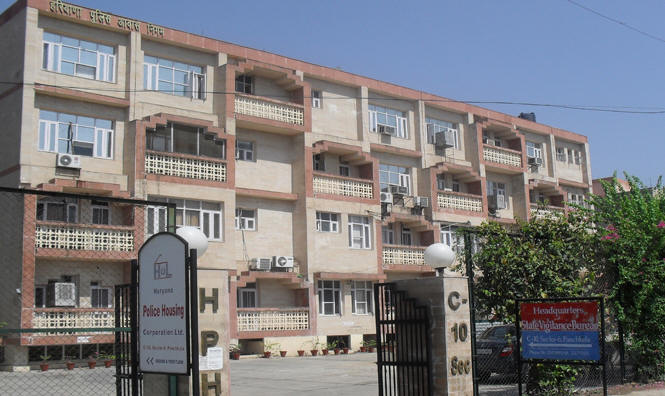
Building of HPHC
Haryana State Enforcement Bureau
To facilitate enforcement of various state laws targeting illicit activities such as liquor smuggling, electricity theft,
water theft, and encroachments, operating beyond routine policing to address specialized violations.
Cyber Haryana is committed to creating a safe, secure and resilient digital environment in the State of Haryana through
technology-driven policing, specialized cyber investigation, capacity building and effective coordination with various stakeholders.
Haryana Cyber Crime Coordination Centre (H4C)
The Haryana Cyber Crime Centre (H4C) provides specialized technical, analytical and cyber intelligence support for cybercrime investigations. It assists in digital evidence analysis, tracing cyber criminals, technical investigation and coordination with relevant agencies, banks, telecom service providers and technology platforms. It manages inter and intrastate cyber coordination through various portals like NCRP, Sahyog and Samanvaya. It also supports capacity building and the effective use of modern cyber investigation tools.
Cyber Helpline-1930
The 1930 Cyber Crime Helpline aims to provide a quick and accessible mechanism for citizens to report financial cyber frauds and other cybercrime incidents. It facilitates prompt reporting, coordination with banks and financial institutions, and timely action to prevent or minimize financial loss by putting a hold on the defrauded amount wherever possible. The helpline also supports effective coordination between citizens, law-enforcement agencies and other stakeholders for speedy resolution of cybercrime complaints. The helpline also houses a bank coordination team which helps in coordination for immediately freezing defrauded amount in the bank account of accused, thus preventing the defrauded amount exit from the system.
Nodal Cyber Police Station, Cyber Haryana
To prevent, detect and investigate cyber crimes through effective use of technology, intelligence and specialized cyber investigation capabilities.
Mobile Blocking Unit (MBU)
The Mobile Blocking Unit of Cyber, Haryana works to identify, verify and facilitate the blocking of mobile numbers suspected to be involved in cybercrime and other unlawful activities. The unit coordinates with field units, telecom service providers and relevant agencies to process requests for suspension/blocking of such numbers, helping prevent their further misuse in fraudulent activities.
Online Crime against Women and Children (OCWC) Wing
The Online Child Welfare Centre (OCWC), Haryana Police handles and coordinates cyber offences against children, including online child exploitation and child sexual abuse material. It supports complaint processing, identification of offences, coordination with police and relevant agencies, and promotes awareness and prevention of online crimes against children.
Data Analysis Wing
The Data Analysis Wing, Haryana Police analyses and interprets crime and cybercrime data to identify trends, patterns and emerging threats. It provides actionable insights, analytical reports and data-based support to senior officers and field units for effective monitoring, investigation and prevention of cybercrime.
Social Media Patrolling Wing
The Social Media Patrolling Wing, Haryana Police monitors social media platforms to identify cyber threats, illegal activities, objectionable content, misinformation and online criminal activities. It supports timely reporting, verification and appropriate legal action.
To dismantle organized crime networks, tackle notorious gangs, and curb interstate drug trafficking.
Haryana State Narcotics Control Bureau
For the prevention, detection, and criminal prosecution of drug trafficking and substance abuse across the State of Haryana.
Police Training College (PTC), Sunaria, Rohtak was established in 2008 to provide quality training to newly recruited and
serving police personnel of Haryana Police. The College conducts Recruit Basic Courses, Promotion Courses, Short-Term Specialized
Courses, departmental examinations and skill-based training programs. The training focuses on developing professional competence,
discipline, leadership qualities, physical fitness, investigative skills and a sense of responsibility among trainees, with special
emphasis on practical and field-oriented learning.
PTC Sunaria is equipped with modern facilities including Computer Labs, CCTNS Labs, Smart Classrooms, CCTV Surveillance and
digital learning resources. These facilities support classroom teaching, practical training, online examinations and
computer-based tests, helping trainees acquire the necessary technical and professional skills for modern policing.
For more information please visit the website of Police Training College, Sunaria, Rohtak:
https://ptcsunaria.haryanapolice.gov.in